A Bicycle for the Mind
By Ethan Maurice | February 28, 2026
The year is 2026, and we’re wading deeper into the technological age. It’s time we recognize something obvious but rarely said: if we take our tech as it comes — out of the box, from the app store, or at sign-up — it will relentlessly try to hijack our awareness.
Most phones, computers, TV’s, websites, and apps today are intentionally designed to hook and keep our attention. From autoplay everywhere that serves us video, to the notification strategies of most apps, to the way opening a social media feed can make twenty minutes just disappear… our technology is now riddled with psychological tricks A/B tested over decades by extremely well funded behavioral psychologists with PhD’s in “Persuasive Technology” with the goal of capturing and keeping our attention for a tech company’s continued relevance, growth, and profit.
Subject to the cumulative effect of all these attention-grabbing tricks, we as humans are more behaviorally addicted to our devices than, well, maybe anything ever before? Walk any city and look around — we are observably more addicted to our phones today than people were smoking at the doctor-approved height of cigarettes in the 1950’s.
A tad dystopic on the societal level, but we, as individuals, still have the freedom to curate our relationships with technology. Crafting our personal relations to technology is where our freedom still lies. We can choose to use a device or not (ex: skip the smart watch and notifications aren’t physically attached to your wrist). We can limit our exposure to an app (ex. just download when needed and delete it afterwards). We can make a habit of unsubscribing from the ceaseless stream of marketing emails that inevitably arrive with signing up for an account or buying anything on the internet.
This may sound like extra work, but it’s become essential to remaining present, in touch with the here and now, and not living as a screen-addicted automaton interrupted twenty-seven times per hour with but fleeting moments of conscious awareness of the real, actual, physical world.
Since I stopped watching TV in 2016, I’ve been curious and consciously crafting my relationship with technology. As a north star for technological relations, I’ve arrived at a simple, single metaphor and maxim. A clarifying phrase Apple CEO and father of the iPhone himself, Steve Jobs, used to market the “personal computer” way back in the 1980’s:
“A computer is a bicycle for our minds.”
Steve Jobs Said Computers Are Like Bicycles
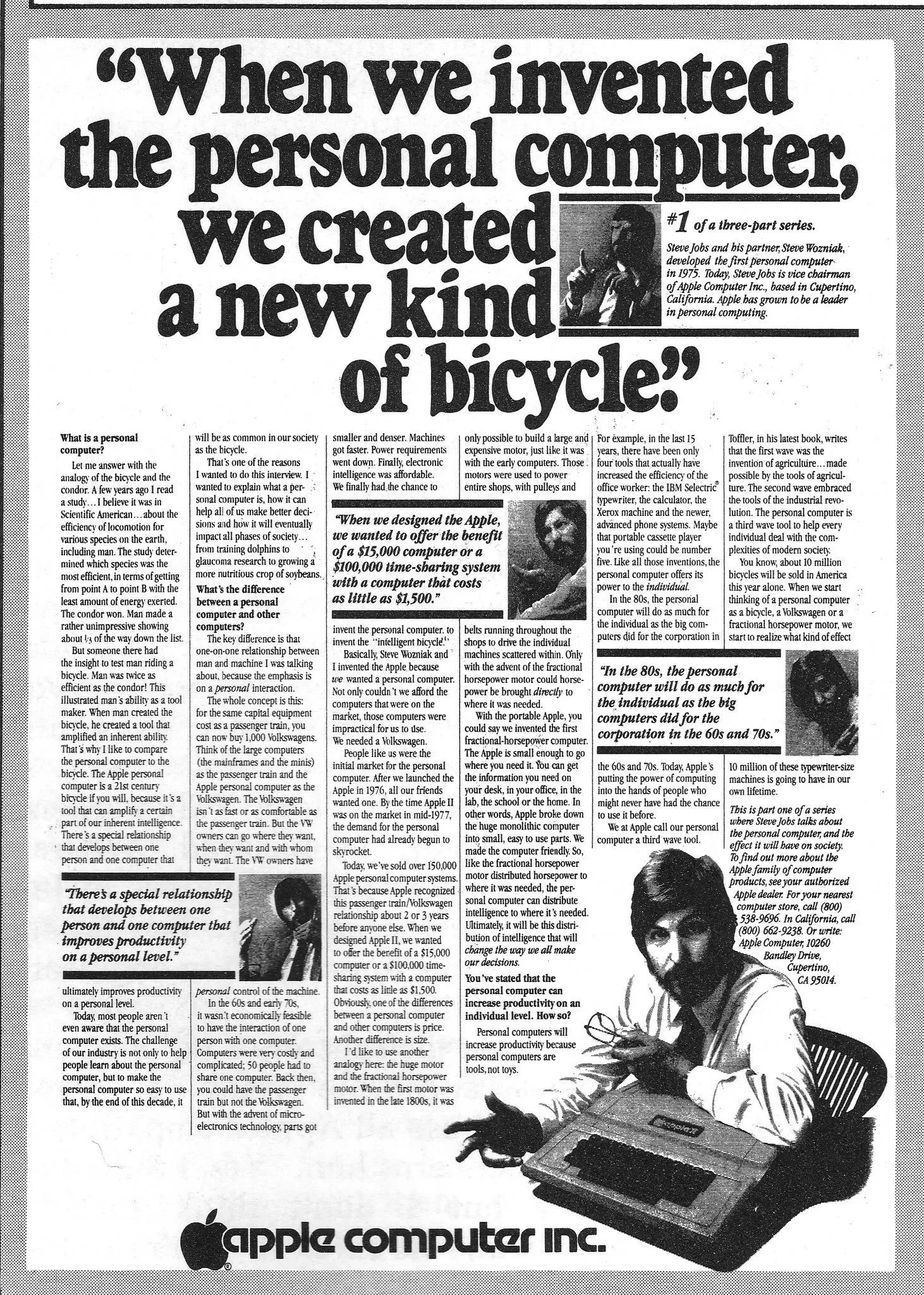
Wall Street Journal ad, 1980 (via Harry McCracken)
Steve Jobs on why computers are like bicycles for our minds (worth watching).
““I think one of the things that really separates us from the high primates is that we’re tool builders. I read a study that measured the efficiency of locomotion for various species on the planet. The condor used the least energy to move a kilometer. And, humans came in with a rather unimpressive showing, about a third of the way down the list. It was not too proud a showing for the crown of creation. So, that didn’t look so good. But, then somebody at Scientific American had the insight to test the efficiency of locomotion for a man on a bicycle. And, a man on a bicycle, a human on a bicycle, blew the condor away, completely off the top of the charts.
And that’s what a computer is to me. What a computer is to me is it’s the most remarkable tool that we’ve ever come up with, and it’s the equivalent of a bicycle for our minds.””
What the Bicycle Represents
As a bicycle lover who’s pedaled across the USA and lived many years largely getting around by bike, to my mind, the bicycle represents the ideal relationship between “man and machine.”
The reason a bicycle is so great is this: it improves our human ability to move with remarkably few unintended consequences:
A bicycle extends our ability to move, without replacing it.
On a bicycle, we are still in the environment, not separate from it.
Riding a bicycle almost always leaves us feeling better, not worse.
Contrast this with driving a car. Driving replaces moving our bodies, we feel separate and alienated from everyone on the road, and particularly when there’s traffic, we arrive feeling worse — all factors contributing to the common term for getting really angry when we drive: “road rage!” Play the daily bicycle vs. car commute out over decades and the cumulative difference can be hard to overstate: in-shape vs. overweight, generally calm vs. stressed, more chronic diseases vs. less chronic diseases etc.
““Cars run on money and make you fat, bikes run on fat and save you money.””
This is not to say “bicycles are better than cars” — cars are way more effective at covering distance — but to highlight how the bicycle is a technology that improves our lives with remarkably few unintended consequences.
Avoiding the unintended consequences of a technology is what the question “is this a bicycle for my mind?” is all about.
“Is This a Bicycle for My Mind?”
Today, whenever I face the choice of engaging with a new technology, the Steve-Jobs-inspired-mind-bicycle question pops into my head:
“Is this a bicycle for my mind?”
If yes — I’m happy to give it a try.
If no — I’m weary of forming relations.
What often separates yes and no answers to the bicycle question is whether a technology is a tool or entertainment.
Technological tools tend to extend our human abilities (like Canva, Zoom, iMovie, calculators, or cameras). Technological entertainment, on the other hand (like Instagram, TikTok, video games, news websites, or TV), is more-so amusement, makes money by selling our awareness to advertisers, and thus, is often riddled with psychological tricks for grabbing and holding our awareness.
Technological tools are typically bicycles for our minds, while technological entertainment often leaves us feeling like we’ve been sitting in rush hour traffic (and tries to pull us back in again and again).
The kicker today is that many technologies land in a grey area on the “is this a bicycle for my mind?” question. Often, a technology can be used with few unintentional consequences, but only if we take the time to limit those consequences ourselves.
As mentioned at the start: fresh from the factory, app store, or upon sign-up, technologies today are often riddled with a bunch of pesky little tricks to endlessly continue to try and grab our attention. Like flies mercilessly invested in landing on our heads, we will be endlessly subjected to them unless we take proactive measures or the time to swat each.
Making Our Tech More Like a Bicycle for the Mind
Today, because so much of our technology comes with grabbing and keeping our awareness baked in, the bicycle question often becomes:
“Can I make this a bicycle for my mind?”
Take our phones, for example. At their default settings, phones and their apps are far from “a bicycle for the mind,” but we can make them closer to one:
Every phone comes pre-installed with dozens of apps we don’t need, but we can delete them.
Apps typically come with notifications on (or strongly encourage us to enable them), but we can turn notifications off for every non-urgent app.
Any app we find ourselves drawn into, we can build more “friction” around — by disabling notifications, hiding it in a folder on our phone, downloading and deleting the app every time we use it, or using the web-based version via a computer browser we don’t typically use (how I access social media).
For making a phone more of a “bicycle for the mind,” the above are my big three. But there are many other means as well, like setting the screen to greyscale, apps that limit screen time on other apps, and literal physical devices that lock/unlock selected apps and features.
We can deliberately craft our relationship not just to our phones, but to our computers, “smart” devices, apps, websites, email inboxes, and any other technology that electronically or psychologically sirens for our awareness.
Mindfulness alone is no longer an effective strategy for presence in the modern technological world. Today, we also need to consciously craft our technology into a kind of “bicycle for the mind,” or forever live with the psychological equivalent of rush hour traffic in our heads.
We might be swimming against the tide at this point, but the choice is still ours.
Choose wisely, my friends.



There are times in life where things are so beautiful and electrically good you can’t even believe they’re happening.
My friends Matthew and Nicolette, brilliant humans, DJs, and the creators and curators of Between2Clouds, are better at manifesting such moments than any humans I have ever met.